What is Postal Cipher about?
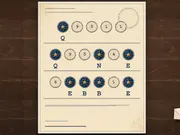
That is the whole trick. A single short word cannot be worked out, only guessed; but the words share one key, and a letter solved in one shows through in the rest. From there it is not luck but deduction: if two words carry the same stamp in the same position, the range of possible letters narrows.
Misses are counted, but there is no allowance to run down. The office does not close, the evening cannot be lost, and a wrong letter costs a star and nothing more - think as long as you like.
96 evenings across six weeks. At first there are three words and half the letters are open; by the end there are four words, almost nothing is given, and the rack holds letters the words never use.
A loupe, a quill and a strike-out help when the cipher holds out.
How do we play Postal Cipher?
Solve groups of words by figuring out which letters are hidden behind matching stamps. The same stamp always represents the same letter across all the words.
What kind of puzzles do we solve in Postal Cipher?
The game features word deduction puzzles where you use repeated stamp patterns and known letters to work out the hidden words.
Does Postal Cipher get more challenging as we play?
Yes. Across 96 evenings, puzzles progress from three words with many letters revealed to four words with very few clues.
What makes Postal Cipher fun to play?
The satisfaction of using clues and deduction to crack each cipher makes the game rewarding, especially as the puzzles become more difficult.
Does Postal Cipher encourage thinking or creativity?
Yes, the game strongly encourages logical thinking and deduction as you compare matching stamps, narrow down possible letters, and solve the words.
Can we play Postal Cipher on mobile?
Yes, Postal Cipher can be played on mobile devices as well as on desktop computers. It runs directly in the browser and does not require any downloads.
Is Postal Cipher free to play?
Yes, Postal Cipher is free to play on Y8 and runs directly in your browser.
Can we play Postal Cipher in full screen mode?
Yes, Postal Cipher can be played in full screen mode for a more immersive experience.
What games can we try next?